

The Case for Curiosity
March 03, 2026
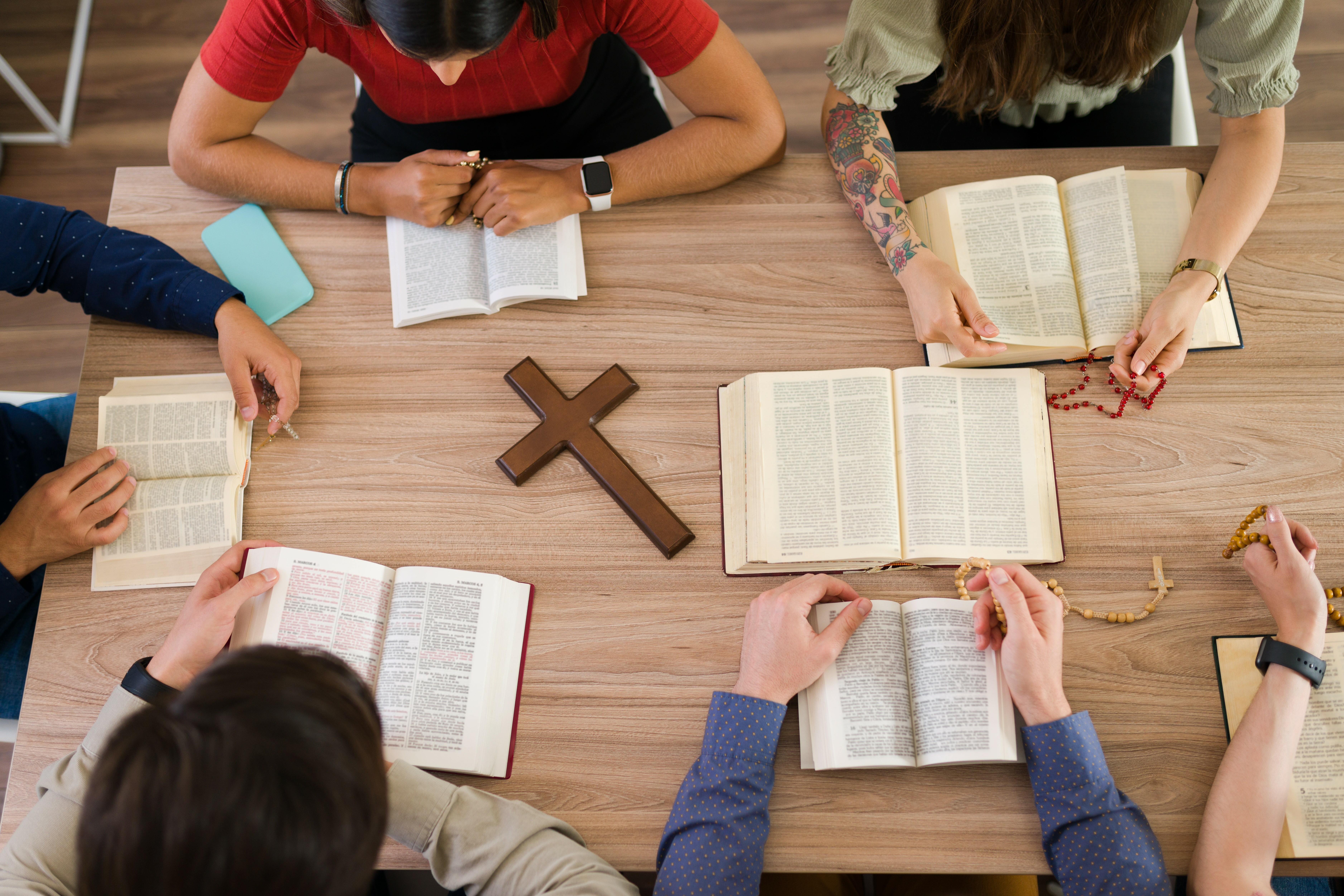
An intelligent mind acquires knowledge,
and the ear of the wise seeks knowledge.
~ Proverbs 18:15
The Hardest and Best Seminary Classes
One of the questions we received during the SJXplained open phone line period was from Mike Renquist. Mike asked:
"I'm wondering, since so many of our staff have recently completed or are still continuing in seminary education: What was your toughest course in seminary? And also, I'd like to know, what was your best course in seminary? Something you really enjoyed? Thank you very much! Those are my questions for our staff."
What follows are answers to Mike's questions from the four seminary-trained members of our current staff, Hilary, Randy, Shelley, and Izzy.
Rev. Hilary Marchbanks, Senior Pastor:
The most challenging class for me was Ethics with Dr. Asante Todd. Books on Christian ethics by James Cone, Traci West, and Walter Rauchenbusch from this class are still on my bookshelf. Those books shaped who I am as a leader today. We also read Calvin, Huebner, Kant, and Mill. Those texts made my head spin; I had to read them repeatedly to try and comprehend them. Not sure I ever did! For more context, this was also an 8 a.m. class and the boys were 2 and 4 years old. Bless!
Old Testament with Dr. Suzie Park was my favorite class. She made the OT stories come to life by giving us a perspective of each Biblical writer, by bringing in nuance of the original Hebrew, and by uncovering humor we would has missed without historical context. She helped us imagine the perspective of the women who had no names and little agency in the text. In that class, Dr. Park helped us examine and gather meaning from the sacred Hebrew stories that Jesus would have known. Her lessons were a gift that I continue to draw from. (Fun fact: Dr. Park is a member of our church!)
Rev. Randy Knighten, Pastor of Outreach Ministries:
Before moving to Austin and attending Austin Presbyterian Theological Seminary, I was a student at Memphis Theological Seminary. In August of 2011 I took a class called Foundations for Peacemaking. It was taught by Dr. Jewell Brazelton and Rev. Dr. Janet Wolf. The focus of the class was to create a biblical, theological, and sociological framework for analyzing conflict. It included the exploration of power and struggle, structural and systemic violence, nonviolent direct action, transformative justice, conflict mediation, and reconciliation. The class was participatory, experiential, interactive, and required openness and critical thinking. We also spent time in community immersion, practical skill training, and group work.
I took the class about a year before the 2012 killing of Trayvon Martin. I really struggled with all of the details that surrounded his death, and I found myself referring to the teachings from the class and its readings on a constant basis. It was the hardest class I have ever taken because of the content and the way that it forced us to take a look at ourselves and the community around us. However, by the end of the semester, it had become the class that I enjoyed and appreciated the most. The required books for the class were Ambassadors of Reconciliation, Volumes I & II, by Ched Myers and Elaine Enns. To this day, those books remain on my nightstand.
Shelley Walters, Director of Faith Development:
The most difficult class I took in seminary was Hebrew. I have never been good at conjugating verbs in any language – which is exactly why I chose American Sign Language as my “foreign” language in undergrad. The language I chose to study in seminary, Biblical Hebrew, does not let you off easy. It belongs to an entirely different linguistic family than English, builds meaning through three-letter roots and shifting verb patterns, often leaves out vowels altogether, and prioritizes aspect over tense. Word order flips, everything is gendered, and meaning is conveyed as much by structure as by vocabulary. My brain worked overtime in that class, and some days it felt like learning to read Scripture through a fog. I hoped it was worth the effort.
That payoff came in one of my favorite classes: a deep dive into the books of Ruth and Jonah with Dr. Suzie Park. This is where Hebrew stopped feeling like an obstacle and started feeling like a gift. The book of Jonah, in the original language, is genuinely funny – full of satire, exaggeration, irony, and wordplay. It gets us acquainted with this reluctant, narrow-hearted prophet named “dove” who avoids going to “the City of Fish” and get swallowed by… a fish. In Ruth, small linguistic choices carry enormous weight, revealing themes of loyalty and redemption that the English language can’t quite capture. Nearly every class session brought some kind of “Oh wow!” moment – those flashes where the text suddenly felt alive, layered, and intentional. That class reshaped how I read Scripture, deepening my understanding that the Bible is not only sacred and serious but also artful, surprising, and deeply human.
Izzy Lopez, Children and Youth Coordinator:
Engaging Youth in Mission and Evangelism with Rev. Dr. Crystal Silva-McCormick has been my favorite class so far. That course has fundamentally reshaped how I understand mission itself. Rather than treating mission as charity, service projects, or something done “for” others, the class invited us to critically examine the colonial histories that have shaped Christian mission and to imagine more faithful, justice-centered ways of participating in God’s work in the world. We wrestled honestly with challenging texts, including Columbus and Other Cannibals; Black Bodies and the Justice of God; and Can “White” People Be Saved?: Triangulating Race, Theology, and Mission, in an environment marked by clarity, honesty, and deep respect. Rev. Dr. Silva-McCormick’s direct and thoughtful teaching pushed us to name hard truths, examine power and privilege, and rethink what “mission work” truly is.
My most challenging class has been United Methodist Doctrine with Rev. Dr. Tom Barlow, which I took as a January intensive through Iliff School of Theology. While the content of the course was incredibly interesting to me, we covered an enormous amount of material in a very short period of time and entirely online! At times, the class felt like drinking from a fire hose as we moved quickly through theology, history, and doctrine central to the United Methodist tradition. Even so, the intensive writing and sustained theological reflection pushed me to articulate my beliefs with greater clarity. The work I completed in this class has helped me feel more prepared for candidacy and for meetings with the District Committee on Ordained Ministry.
March 03, 2026
February 24, 2026

February 17, 2026