

A Lenten Retreat: Connection and Awe
March 17, 2026
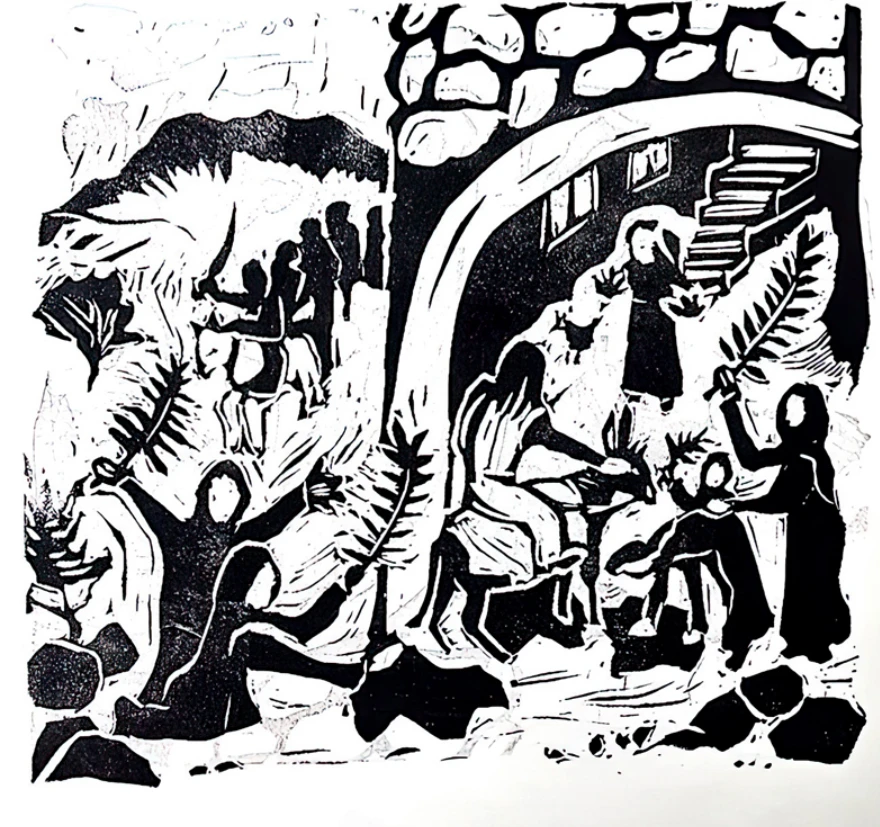
Then they brought the colt to Jesus and threw their cloaks on it, and he sat on it.
Many people spread their cloaks on the road, and other spread leafy branches that they had cut in the fields.
~ Matthew 11:7-8
Self-Giving
As a child I remember staring at the sky. I would lie back on our uncovered porch and look up at the clouds. As I stared up at the sky, I would attempt to guess the shapes that were being formed by the clouds that passed above me. As I look back, discovering new shapes and forms in the clouds filled me with a sense of awe.
According to Greg Rienzi’s article, “The Science Behind Why We See Faces in Nature,” we, as humans, are hardwired to discern such recognizable and often meaningful patterns, a psychological phenomenon referred to as pareidolia (pronounced par-i-DOH-lee-a). We see the face of a person in the knots of a tree, the shape of an animal in the clouds or a person on the moon. Stemming from the Greek words para, meaning "beside," and eidolon, meaning "image" or "form," pareidolia is often associated with finding or assigning human physical characteristics in nature. It can even include hearing distinct sounds that only appear to be there, like voices or music in flowing water — often referred to as auditory pareidolia. In Mark’s retelling of the “triumphal” entry of Jesus, the scene may have had the appearance of a simple parade of donkeys, cloaks, palm branches, and shouting people. But maybe it was something else altogether. Maybe, as onlookers of this biblical scene, we initially only see what is at the surface of what is being played out before us. However, if we look a little deeper maybe we will see more.
Theologian Ched Meyers says that the long march of Jesus to Jerusalem takes Mark’s story from the margins of Palestinian society to its center. Arriving at the suburb of Bethany, Jesus enters the Holy City not as a reverent pilgrim demonstrating allegiance to the Temple and its rulers, but as a subversive prophet challenging the foundations of State power. Mark chapters 11-12 narrate Jesus’ campaign of direct action towards those that were making life very difficult for the people around him. Jesus continually gave of himself to improve the state of those that were downtrodden and pushed down by life and world, those who lived with their backs against the wall, as Rev. Howard Thurman would say. I am sure that many who attended the palm parade of Jesus that day likely stood in awe of his bravery and his beautiful act of solidarity.
A sense of awe can include witnessing acts of “moral beauty.” Jesus’ entrance into Jerusalem was such an act as he continued his ministry of lifting up the cause of the lowly and advocating for the power of peace and justice. Research shows that when we witness with awe others’ kindness, courage, strength, and overcoming, we are more likely to feel inspired to give ourselves in service of the good. We become more self-giving, more ready to lend a helping hand or commit energy to making the world a better place. (Dr. Marcia McFee)
As we continue to journey through this season of Lent may we consider two questions. What acts of “moral beauty” have you found awe inspiring? What are those acts inspiring you to do?

March 17, 2026

March 10, 2026

March 03, 2026